For several years, a poem simmered deep inside me. I can’t remember the exact moment the words entered my consciousness, but I recall repeating them over and over to myself when doing the farm chores and elsewhere.
I shall be young again…I shall be young again...
Becoming a dad is, without a doubt, one of the most life-altering moments for most men. It shifts your perspective of life in many ways.
As one of my church brothers stated in a conversation recently “we live vicariously through our children”.
It’s true.
Through the sensory experiences of the little ones, we are drawn back to our own childhood. We remember the wonder, the enchantment, the imagination, the innocence. And in a small way, we experience it again through them.
And we mourn. Both the scars of our own coming to age, along with the certainty that they too will walk that same old well-worn path out of Eden.
When our third baby was born, I finally took the time and mustered the discipline to wrestle those simmering thoughts to the confines of written word. If it blesses you, feel free to share.
___________________
Young Again
A hopeful lament of a father’s heart
Cradled with tenderness, nourished by love, Hedged in and protected from below and above. Unmarred by rejection and oblivious to harm, He connects with each face– and is instantly charmed.
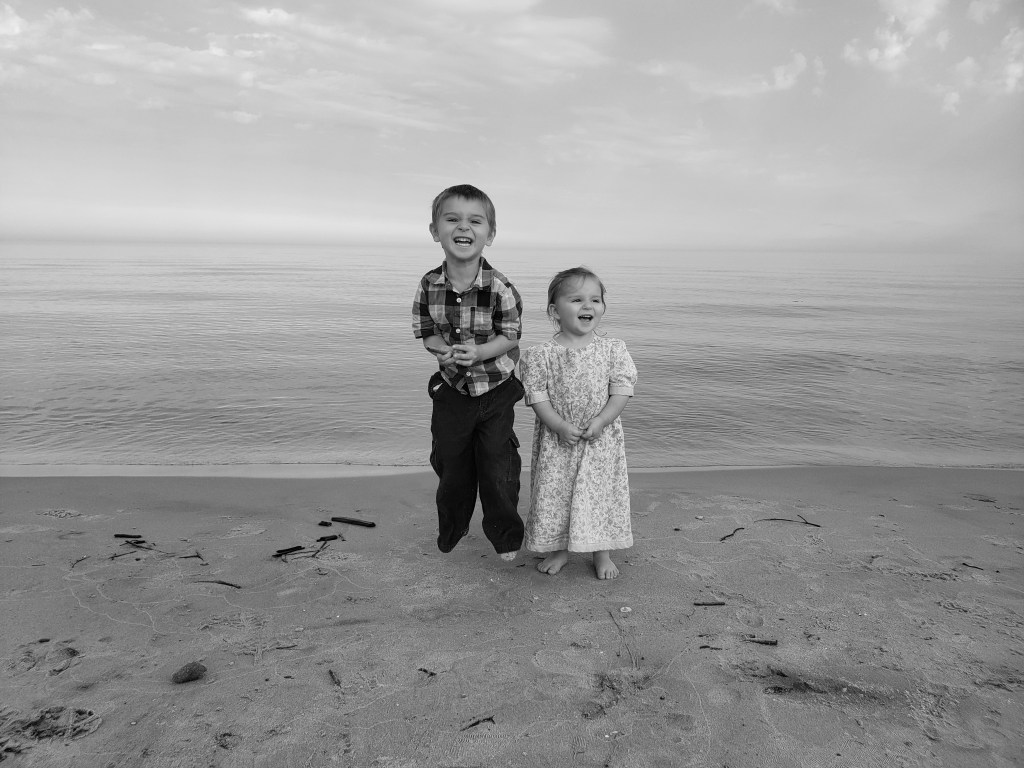
Barefoot exuberance, lights in her eyes; Skipping and singing– gasps of surprise. Frizzled-hair happiness, strawberry-stained cheeks, Innocent reverie– pure joy when she speaks.
Eye-opening wonderment– There’s a world to explore He’s drinking in knowledge and begging for more. How vast is our galaxy? How deep is the sea? His pursuit of the universe– unbridled and free.
But the joy that I feel, as each milestone you pass, Is mingled with sadness– life travels too fast. For Eden recedes with each calendar page, And infancy’s innocence dwindles with age.
Into the shadows of self you will creep; You’ll hide from the Voice, and you’ll curl up and weep. Then cowering with shame in this old Adam’s world, You’ll be driven from paradise by a cherubim sword.
I pray that the wilderness leads you to Him; That in stumbling and knocking, you’ll find refuge from sin. That the spark in your soul not succumb to the night, For the burden He offers is somber– yet light.
This living and dying, as we know it today, Whispers a future that will take us away Where the garden stays green, and the connections we’ve had Will then be much deeper – and infinitely wide.
I shall be young again! Oh, I shall be safe– Enveloped in Love’s eternal embrace. I shall be young again– yes, I shall adore The face of my Savior– I’ll slumber secure.
I shall be young again, I shall be free; Running through clover fields – skipping with glee. Yes, I shall be young again, childhood restored; My questions all answered in a clean, fresh world.
Let the wave of Redemption swallow up all decay. May these pangs of corruption give birth to new day! Deliver creation– as You promised of old. Let me be young again, Oh– let forever unfold!
As a teenager, I was part of a small group of friends who started a literature publication called the “Pen Upon the Paper”. We wrote poetry, prose, and short stories which were published in our little paper along with our critiques of each others’ work.
Our little paper, which actually gained a few subscribers (mostly from supportive friends and family) eventually was renamed “The Inkling” in honor of Lewis, Tolkien and Co.
Our writing and publishing project flourished briefly like crocuses in early March and then quickly wilted away as one contributor after another became sidetracked, engrossed, called, etc. to other fields of life.
I’m sharing the piece below because it speaks to the very name and ethos of my blog, and because it relates to the topic of an essay which is currently brewing and stewing within me.
I was 18 years old when I contributed this to the Inkling– probably one of the last before I dropped it altogether. Reading it today, I was tempted to make a few changes- I’m not sure why I imagined the disciples were big, burly men. (except Peter- I still imagine him as a big man, for some reason). And I’m pretty certain it would have been highly unlikely to see a blonde-haired, blue-eyed child in 1st century Israel… but I will honor this younger version of myself, and refrain from editing it.
Who is the Greatest? Matthew 18:1-4
Of course, the question came from Peter.
But the rest of them wanted to know too, and they stood around the Master⎯tense, and a little embarrassed maybe, hoping he wouldn’t know why they asked. Big men with snarled beards and weather-beaten faces; big men with a big question.
They waited for His answer, for He always had the answers it seemed. He said nothing but turned to them and His eyes were sad and deep.
They thought he must have misunderstood when he knelt down in the sun-speckled grass where a young family ate their packed lunch in the shade of a towering sycamore. He held out his arms to their son, a chubby little fellow just learning to walk, with tousled blond hair like sheaves of corn and sparky blue eyes like the Sea of Galilee.
“Come, sweet child” He said. “Come here a second.”
The little boy looked at his mother⎯she smiled and nodded. Then he tottered right into the arms of the Master and stared into His face with large sober eyes. Eyes that revealed the bottom.
Andrew coughed; Nathaniel stroked his beard. The little boy gazed at them, completely unaware of all those things such as the kingdom of heaven and jealousy and fear and competition and…
The grass waved; locusts droned their monotonous tradition. The Master squeezed the little fellow again and set him down to go back to his mother who stood to one side, watching as only a mother can watch.
The Master stood and brushed off some dust. And the big men hung their heads, because somehow…somehow they knew the answer. Before He opened his mouth, they knew what He would say.
“The mob went along with the Sadducees and Pharisees, the philosophers and the moralists. It went along with the imperial magistrates and the sacred priests, the scribes and the soldiers, that one universal human spirit may suffer a universal condemnation, that there might be one deep, unanimous chorus of approval and harmony when Man was rejected by men.” — G.K. Chesterton
Jesus of Nazareth climbs up the muddy banks of the Jordan river and sets his gaze towards the wasteland. What awaits him are wild beasts, physical and spiritual alike.
Millenia before, the first man and the mother of all living were gifted a luscious paradise to dwell in. In close proximity to their Creator and surrounded by fruit of every kind, they still fell for the lies of a hissing rebel who offered the succulent forbidden couched in terrible half-truths.
Now the Last Adam, stumbling through a parched wilderness, his body wracked with hunger pangs and mouth intolerably dry, also faces the tempter. The “angel of light” offers Jesus a dazzling package of satanic sustenance, self-willed supremacy, and frivolous fame . But this time, the serpent turns tail and slinks away, banished by the swift, clear-eyed response of the obedient Son. “Away with you Satan! For it is written…”
The Servant, mentioned repeatedly by the prophet Isaiah, wanders in the wilderness one day for every year which the rebellious generation in Moses’ day had suffered. Jesus passes the test that all before him had failed. Now angelically refreshed and full of the Spirit, the Son of God turns back towards Galilee to begin a mission.
Operation The Kingdom of Heaven Is Here commences with the calling of His disciples- a ragtag group of fishermen, zealots, a tax collector, and otherwise.
He opens the scroll of Isaiah in the little hometown synagogue and declares his mission before bewildered, soon to be enraged keepers of the law who are incensed by the gall of this son of Joseph “whose mother and brothers we know”.
“The Spirit of the LORDisupon Me, Because He has anointed Me To preach the gospel tothepoor; He has sent Meto heal the brokenhearted, To proclaim liberty tothecaptives And recovery of sight tothe blind, Toset at liberty those who areoppressed; To proclaim the acceptable year of the LORD.”
“Today, this scripture is fulfilled in your hearing,” Jesus says. The Nazarene church-goers are confounded…then infuriated. They mob and push him to the edge of cliff with intent to kill.
Sitting here at my computer in 2026, surrounded by bookshelves filled with multiple Bible translations along with many and varied theological and historical resources, I no longer have the disdain for those people that I did as a youth. Instead, I am humbled and grateful that I have been given the perspective that enables my belief. Would I react any differently to a homeboy with messianic hallucinations?
Outside of his boyhood stomping grounds, the working-class crowds amass around Jesus, astonished at his teaching and stupefied by his miracles. The water turns to wine, the basket of bread and fish multiplies, the storm domesticated, the lame jump for joy, the leper loses his spots, the blind sees the sunrise, the deaf hears his name for the very first time.
And the dead are raised to life.
Physics and chemistry are turned on their heads . Meteorology and medicine are bent to His will. The One who created water now walks upon it with ease.
But the crowds begin to thin when confronted with the hardness of his teachings.
Being saturated from little up in the goodness of Christian doctrine and tradition can numb us to the jarring character which the four gospel writers portray. There is a tendency in each one of us, I believe, to mold us a Christ in our own image; to overtly emphasize a particular statement or action of the Lord, while smoothing over the parts of him that feel too scandalous.
There is a tendency in each one of us, I believe, to mold us a Christ in our own image
Jesus breaks all molds. He challenges all sentiments. The same man who tenderly cradles the young children and blesses them, also braids a whip in righteous fury, overturning tables and scattering those who prioritized commerce over consecration.
When we long for comforting platitudes, Christ delivers a scandalous line about eating his flesh and drinking his blood.
When we desire a simplistic truth capsule, He offers a perplexing parable and tells us that if we have ears, we need listen up.
When we wish to reason, to justify ourselves, to add layers of nuance upon disclaimers, Jesus deftly wipes away all ambiguity with a crisp one-liner that cannot be misinterpreted.
The greatest irony of Christ’s teaching perhaps, is that many world religions and philosophies wish to take a piece of it for themselves while rejecting the most fundamental claims that He made of himself.
C.S. Lewis states it well in his “lunatic, liar, or Lord” argument:
” Either this man was, and is, the Son of God, or else a madman or something worse. You can shut him up for a fool, you can spit at him and kill him as a demon or you can fall at his feet and call him Lord and God, but let us not come with any patronizing nonsense about his being a great human teacher. He has not left that open to us. He did not intend to. … Now it seems to me obvious that He was neither a lunatic nor a fiend: and consequently, however strange or terrifying or unlikely it may seem, I have to accept the view that He was and is God.”
Back in Judea, somewhere around 30 A.D. the carpenter from Galilee had the very effect upon his listeners which Lewis describes. Jesus’ earthly ministry culminates in bitter betrayal, late night arrest, indictment of blasphemy, and a death sentence.
And so, we find ourselves at a very dark place indeed, gathered around a gruesome crucifixion scene on a hill outside Jerusalem. Here convene those that love Him as Savior and friend with those who hate Him as a blasphemer and rabble-rouser. Here the sobs of mourners mix with the taunts of gloaters.
Now let us focus upon a certain oddity which plays out near the foot of the cross.
The Suffering Servant, stripped naked, gasping for breath and bleeding out, cries out in agony and forgiveness. Just a stone’s throw away, a team of calloused Roman executioners passes away the time with a game of dice. The prize- His robe.
The great empire is at peak strength, its iron grip extending to all parts of the known world. These men from the local garrison could have been Italian or they may have been auxiliaries from any part of the conquered empire: Greek, Persian, Armenian, Thracian, etc. Together they divide His garments with the swipe of a dagger.
I see in this a greater story, one that continues on throughout history. For it seems that many world religions are gathered around the cross even today. They divide his garments- each one eager to claim their part of Christ, yet each one loathe to accept His all-encompassing claims.
Judaism is there in that group, recognizing Jesus as a historical figure, howbeit, just an ordinary one. Judaism is present to insure that the crucifixion job gets done right. Yes, Jesus did great works, but he did so by the power of Beelzebub. Blasphemy is punishable by death.
Islam crouches in very close proximity to the Suffering Servant. This one accepts that Jesus was born by miraculous conception, and supported by divine miracles. A great prophet was he indeed! But Islam keeps his back turned towards cross…and even today declares with fury “he wasn’t crucified!”
Buddhism wants its share of Christ’s garments too. We are similar, in many ways, he purports, both striving for love, compassion, and peace in suffering. Jesus is another Buddha, one who has reached the pinnacle of enlightenment. And we all can achieve the same.
Hinduism doesn’t want to be left out either. Jesus is a “holy teacher”, a yogi, an avatar of the divine- a paragon of divine love and non-violence. Jesus should be respected as a holy martyr.
New-Age and Universalism has even found a spot in that group of soldiers. Jesus was “Christ”…but so are we. He was an enlightened Master- one to be admired and emulated. He had achieved “oneness”- a state of consciousness that can be reached by us if we open ourselves to it. Yes, Jesus was a way to God, but so too are all other paths..
Yet all of these religions fail to fully address the epic and exclusive claims that Jesus made.
“Before Abraham was, I am.”
“I am the Way, the Truth, and the Life.”
“No man comes to the Father except through me.”
Jesus Christ is not some modular genie who can be reimagined and rearranged to fit our own perceived notions and whims. Those who huddle by the cross in close proximity, dividing his garments would like to fit him into their worldview. But Christ can’t be divided. Rejecting any part, they have rejected him in whole.
That terrible and wonderful Friday draws to a close. The bruised body of the Suffering Servant is taken down from the cross and prepared for burial.
Spices. Graveclothes. A tomb. A large stone.
It’s over. Jesus of Nazareth is dead at thirty-three. And that is where his story should end. Natural law demands it.
Yet, the seekers, the followers, those that have come to love him dearly, will find themselves drawn towards the tomb on an early Sunday morning with hearts battered yet sheltering the tiniest spark of hope.
The third phase of Christ’s revelation allows no middle ground. It’s the most wonderful story you’ve ever heard.
If you dare to believe it.
To be continued.
To read the introduction and Part 1 of the series “Which Jesus do you worship” click the links below.
We were a typical starry-eyed newlywed couple dreaming about the future.
In a hazy honeymoon memory, I recall leaning against a hotel balcony alongside my lovely new wife, in the darkness somewhere on the east coast of Florida, discussing baby names.
My wife has a different memory; one that apparently got wiped from my internal hard drive. She says there was one name I wouldn’t tell her. It was rather uncommon and I reckon I was a bit sensitive about blurting it out. She needed to guess it. So, I made her play the legendary little “hang-man” game while we drove the interstate.
Well, the poor little man got hung good and proper, and there still remained blank spaces of unguessed letters. When I did finally tell my wife the name I had in mind, she tried to let me down gently.
“Aww…” she paused….”I don’t know… maybe if we get a horse someday you can name her that.” She knew I liked horses.
Not exactly a ringing endorsement. But what can I say? I’ve vetoed a lot more baby names in my fathering career than she ever has!
As a teenager I read Katherine Marshall’s best-selling novel Christy. Google tells me that since it’s 1967 publication, the book has sold over 10 million copies, so I guess I wasn’t the only one who found it to be an engrossing read.
Christy would be categorized as “historical fiction”, inspired by the real-life experiences of the author’s mother.
The narrative follows a 19 year old girl named Christy Huddleston who leaves her home to go teach school in a poor isolated Appalachian community.
As I remember, Catherine Marshall, through this story, expertly draws out the deep, complicated nature of human relationships and experiences. It doesn’t hold back from the real, the raw, the ambiguities that a lesser writer might shrink from.
Birth, growth, suffering, hope, joy, dreams, friendship and death…it’s all there in Christy. The final pages left me in a blubbering mess. I wept somewhere behind a locked door, knowing how difficult it would be to explain to an inquiring family member the cause for my tears.
There was a female character in the story named Fairlight. I loved everything about the name. The sound it made on my tongue, the simple yet picturesque meaning, the way it spoke to my soul’s imagination. And I thought to myself, If I ever have a little girl of my own, I want to name her Fairlight.
Many years have passed. Somewhere along the way, my wonderful woman warmed up to the name…and even started to like it!
“I think you’ll have your Fairlight someday”, she would tell me. I hardly dared to hope. God had already blessed us with two boys and a girl. Maybe Fairlight would only live in my dreams and Catherine Marshall’s best-selling novel.
I had thought about “Fairlight” so long, it was as if a little person were already attached to her name in some mysterious way. Like an old friend, who I hadn’t yet had a chance to meet.
When the ultrasound showed our 4th child to be a girl, my heart surged. God willing, I would meet my Fairlight!
Over the past months this little poem gestated in my heart, along with our growing unborn child. And this Thanksgiving weekend, as I rock my little Fairlight, I will sing it to her:
Oh Fairlight, I have known you As a dreamer knows a dream Where light and shadows mingle Mid’st the grey of in-between
Your name has long been tapping Like a drumbeat on my heart; Your visage long since waiting For its fullness to impart
How silently and skillfully You’re crafted in the dark; A spirit-flesh mosaic From a supernatural spark.
Your days have all been written By the Master of the plan, Your thoughts already precious To the One who holds your hand
Seems I’ve loved you now, my daughter, For a hundred years or more – Old time friends who’ve never spoken; Strangers who have met before
Now with breathless expectation At the window of the womb I stand, eager to embrace you- Oh my Fairlight, welcome home!
Last week, I took my family to visit the Smithsonian Air & Space Museum near our nation’s capital.
We walked through the huge hangars which are packed with real historical pieces of mankind’s great 20th century invention: air travel and space exploration.
They have it all there at the Steven F. Udvar-Hazy Center- From the crude piecemeal constructions of early flight to the incredible sleek design of the SR-71 Blackbird, that military marvel which could fly 16 miles high and outrun a bullet.
Maybe the most impressive of all is the massive space shuttle Discovery now confined to a lowly building of concrete and steel, after her exciting career which consisted of 39 space missions over the span of 27 years. By retirement, she had accumulated just under 150 million miles on her odometer.
We finished up our visit at the Airbus IMAX theater, which itself is a testament to human ingenuity. The screen is 86 feet wide and towers 6 stories high, immersing the viewer in heart-thumping sights and sounds.
DEEP SKY, one of their latest feature films, takes you behind the scenes in the design, building and deploying of NASA’s James Webb space telescope (aka JWST).
The James Webb space telescope is a gargantuan accomplishment of human engineering and technology. It orbits the sun one million miles away from earth and captures unprecedented views of deep space through its ground-breaking INFARED technology.
From its conception, the telescope took over 30 years to reach completion, including a major redesign in 2005 and 5 years of testing, before the final assembly began in 2019.
A rocket launched the 10 billion dollar beauty into space on December 15, 2021 from a space port in French Guiana, South America.
Even after launch, there was so much that could have gone wrong. One engineer explained that there were over 300 individual “single-points of failure” involved in the process of getting JWST into working order. In laymen’s terms, that means if anything went wrong at any of those 344 junctures, the amazing telescope would have become useless space junk.
“The most complex sequence of deployments ever attempted in a single space mission.”
It was a fascinating presentation, for sure. Some of the JWST team members teared up on camera as they described the emotional moment of launch and then the long-awaited photographs that were beamed back to earth months later.
However, in my perspective, the most jarring part of the film were the words left unsaid. That blaring omission that you couldn’t miss. There was an elephant in the room.
God.
Over 20,000 of the brightest minds from 14 countries convened to invent, create, test, and deploy this marvelous irreducibly-complex machine, of which the tiniest malfunction would have totally ruined its purpose and task.
Yet, they want me to believe that mindless, unguided processes produced the vastly more complicated biological life on our planet.
Under the guise of “scientific exploration” the film’s true spiritual nature quickly became apparent.
“Where did we come from?” How did the universe begin?” “Are we alone?” These questions reverberated from the massive speakers into the sparsely-filled seats of the theater.
The NASA personnel and the producers of DEEP SKY would likely disagree with my assessment that these are questions which arise from a spiritual place in the human heart.
“He has set eternity in their hearts” says the wise king in Ecclesiastes. “Except that no one can find out the work that God has does from the beginning to end.”
The film continued on, showing the stunning photographs taken by JWST, that allow us to “look back into time”, to the early stages of the universe. They described “star nurseries, explosions, and colliding galaxies.
Exploding stars, they tell us, expel carbon, hydrogen, nitrogen and the like into space. These chemicals are known as the “building blocks of life”, and therefore these supernova explosions “seed” the next generation of stars and planets, from which life will eventually form.
Mr. Gray-Haired Bespeckled Professor man onscreen then answers the first spiritual question- where did we come from?
The universe, he tells us, is in a never-ending cycle of birthing and dying stars. “We are all made of stardust. We are simply recycled stardust.”
He pauses, perhaps grappling with the full philosophical implication of his statement. Then he shrugs and smiles.
“…And that’s ok.”
Selah.
There it was. The conclusion of the whole matter. We are recycled stardust.
What it really is, however, is just recycled paganism. Who would have known that at NASA in 2025 you could hear a warmed-over version of reincarnation from the ancient eastern religions?
If you and I are just accidental products of star explosions, then the only logical conclusion to draw is one of complete and utter nihilism.
A devout materialist must adhere to the belief that there is no such thing as a “mind”- only a brain, derived of random stardust, firing its receptors for no apparent reason, and to no apparent end.
Thus, all the non-material realities that every human being intrinsically knows to be important and most sought after…those things called we call love, happiness, hope, dreams, longings. These also, must have no meaning.
Of course, deep down in, very few people actually believe this. The little whisper of eternity placed within our hearts knows it to be false.
But if you preach the gospel of nihilism long enough, some young souls, grasping for meaning and purpose in their life, will start to believe it. And then act on it.
We live in a culture which is suffering a real crisis of meaning. Most astute non-believers will even tell you that.
Young men living in the basement, terminally online, sucked into a vortex of fringe message boards, dark memes, and violent video games don’t always act upon their personal meaning crisis.
But some do. And when they do, innocent people usually die.
Nihilism scrawls weird, cryptic, self-contradicting messages on shell casings and then goes out in attempt to create some meaning of its own. Stardust speeding up the recycling process a bit. That is all.
Nihilism scrawls weird, cryptic, self-contradicting messages on shell casings and then goes out in attempt to create some meaning of its own.
The film ended. Part of me wanted to spit in disgust at the screen. Another part wanted to turn around and preach Jesus to my fellow audience members.
Those who know me won’t be surprised to learn I did neither.
Instead, at a nearby restaurant, as we waited for our food to arrive, I put my arms around my 9 year old son and 7 year old daughter who were sitting on either side of me.
“Children, I want you to know something. You are not recycled stardust,” I said.
Sometimes, when I want to feel smaller than I already do, I walk outside to the night sky and look up.
First, my eyes are distracted by the steady-moving unblinking low-orbit satellites that constantly crisscross our modern skies. Yeah, Elon, you’re pretty impressive! Mankind has taken some giant leaps, indeed.
But I’m looking for something better.
I’m reaching for the stars tonight. Their tiny points of light above me wink back at my smallness. Any random part of the night sky I gaze upon are myriads of swirling worlds, billions of light-years away. (or so, they tell me). Vast galaxies and suns that dwarf our own.
I scan the horizons, which are hemmed in by hills and houses and polluted by nearby city lights in my part of the world, But I can picture in my mind our blue-green planet spinning in space. Zooming out from my own perspective, I can see my small form rapidly lost in the darkness, and the horizons being quickly expanded into the curvature of our terrestrial ball.
The yellow blinking gridwork of human infrastructure appears as a bit of glitter sprinkled over a dark canvas. Soon earth itself is just a speck as we move outward at a speed much faster than light (for to travel at such a plodding pace would require too much time for my little mental exercise).
Now I have escaped the little playground of our solar system and wave goodbye to Pluto (poor little ex-planet) as I dodge through the protecting Ort Cloud and make a beeline to our nearest star, Proxima Centauri, just over 25 trillion miles away.
Then on I travel until our Milky Way galaxy looks like a little toy pinwheel thrown carelessly from a child’s hand. Next destination is its nearest Galactic neighbor, Andromeda. They tell me that travelling at the speed of light,(which is impossibly fast in reality…just ask a certain wild-haired German physicist) would take us 2.5 million years to reach Andromeda. But I’ve already arrived and am still hurtling onward. From here, the Milky Way would be just a very hazy smudge to the untrained alien eye. It’s suns, our solar system, and beautiful little earth would be invisible.
From here I see billions of galaxies, each teeming with billions of stars and shrouded in secrets. From here, giant supernova sparkle, and colorful nebulae tower upward through incomprehensible dimensions. From here, black holes loom ominously- even light rays shuddering at the thought of entering those gaping dark doors.
Although I’ve barely crossed the threshold of my dwelling for a proper tour of the universe, I’m ready to call it a day. I feel quite small. Actually- incredibly and distressingly insignificant.
When I consider the heavens, the work of Your fingers, the moon and the stars which you have ordained- What is man that your are mindful of him, and the son of man that you visit him? (Psalm 8)
Me too, David. Me too!
Over three thousand years ago, the son of Jesse was lying on his back staring at the night sky, feeling small. When did he write this psalm? Was it on a dark hillside on the outskirts of Bethlehem with his dad’s sheep? Was it a moonless wilderness midnight, as a hunted fugitive, surrounded by his snoring group of 400 ruffians? Or was it later in life as king, at peace in Jerusalem, gazing from his rooftop palace vista?
We moderns are often guilty of “chronological snobbery”; looking down our noses at the ignorant ancients who knew nothing of rotating planets, ort clouds, and swirling galaxies. Or did they?
I expect the night sky in 1,000 B.C. declared the glory of God’s handiwork far louder than my polluted view does today. Whatever the case, David knew enough to know that he didn’t know much at all. What’s important however, is that David turned his feelings of smallness into the largeness of praise. He worshiped.
What’s important however, is that David turned his feelings of smallness into the largeness of praise.
O Lord, our Lord! How excellent is Your name in all the earth!
A few nights ago, after being awakened in the wee hours of the morning by our two-year old climbing into bed with us, I struggled to fall back to sleep. I sipped a bit of water from our nightstand and glanced out the window. I caught my favorite constellation, the mighty Orion, resting on his side upon the Blue Ridge mountains in the east.
Lying down again, my mind fired up a rowdy pinball game, gleefully bouncing around tomorrow’s impending conversations, stress and responsibilities. Deep sleep evaded me.
For some reason, in that strange transitory period between wakefulness and slumber, I suddenly wondered what God’s conversation with a modern-day Job would sound like.
You see, Job got grilled. Big time. God spoke out of the chaos and talked directly to him, which is kind of a big deal on its own merit, if you know what I mean.
But instead of answering Job’s desperate pleas for somebody to make some sense of his suffering, God instead took him on a virtual tour of the universe, peppering him with unanswerable questions.
“Who is this who darkens counsel by words without knowledge?” God asks. In everyday terms: Who are you to question My wisdom and authority with ignorant words?
Prepare yourself like a man and answer! Gird your loins, Job. Buckle up!
Many of the questions God asked Job still cannot be answered today:
Where were you when I laid the foundations of the earth? Have the gates of death been revealed to you? Can you bind the bind the cluster of Pleiades or loose the belt of Orion? Can you lift up your voice to the clouds that an abundance of water may cover you? Have you given the horse strength? Does the hawk fly by your wisdom?
Job: [crickets]
But one could argue that some of the questions asked by God, would have a ready answer from today’s enlightened intellectuals. For example:
Have you entered the springs of the sea, or have you walked in search of the depths? Have you comprehended the breadth of the earth? Have you entered the treasury of the snow, or have you seen the treasury of the hail? Do you know when the time when the wild goats and deer bear young? Can you number the months they fulfill?
Well, yes. Mankind has spent thousands of years accumulating vast knowledge of science. Our insatiable curiosity of how our universe functions, backed by the deep gnawing questions of meaning and purpose drive us to observe, research, calculate and theorize to this day.
But under every turned rock of scientific discovery is a horde of creepy crawly questions that we just can’t seem to stamp out.
Under every turned rock of scientific discovery is a horde of creepy crawly questions that we just can’t seem to stamp out.
In fact, I would argue there is direct correlation between our gained knowledge and the awareness of how much we don’t know. The more you learn, the smaller you become.
And so, the other night at 4 AM, I pictured a long line of the Enlightenment’s brightest minds, secular and religious alike, being questioned by Almighty God.
Prepare yourself like a man; I will question you, and you shall answer Me.
Congratulations, Sir Isaac Newton! I heard an apple fell on your head and got you thinking. You’ve discovered the law of gravity. Now tell me- how does gravity actually work…and from where did it come from?
[Silence]
Mr. Einstein, step right up! I’ve heard a lot about you, and I’m expecting some brilliant answers. E=mc2. Pretty impressive! Now tell me- what is this stuff called dark matter, that “invisible glue” that holds together the galaxies? And the dark energy, that is instrumental in acceleration the expansion of the universe? Where did it come from? Where you there to help me fashion it?
[Shrugs]
Mr. Watson and Mr. Crick, it’s your turn. You’ve figured out that the cell is slightly more complex than the “microscopic lump of jelly-like substance” that your forefathers ascribed it to be. You’ve discovered the double-helix coil of deoxyribonucleic acid. DNA! Excellent! Now tell me- where were you when I designed this biological replicating marvel? Can you explain how such a fined-tuned, intricate system can begin? Put on your big boy pants and answer me!
[Shifts feet]
Francis Collins! You headed up the Human Genome project and successfully mapped it entirely. You discovered the longest word known to man; 3 billion letters of coded information embedded within each DNA cell of every person who has ever lived. Each one a complete instruction manual to the function and development of human life. Were you there when I wrote the code of all living things? Tell me- can you speak life into existence from inorganic and inanimate substances?
[Bows head]
We’ll stop there, but the list could go on and on. All of the brilliant men mentioned were instrumental in world-changing scientific discoveries. Their religious views ranged from atheist to deist to Christian. One thing is sure: their discoveries didn’t answer all our questions. If anything, they’ve uncovered many more.
I once heard the late, sharp-witted atheist Christopher Hitchens talking about a conversation he had once with his own child, who wondered how the “Big Bang” started. His answer went something like this.
“Picture everything that ever was and ever will be in the universe…picture all matter and all energy compressed into a small, black travel suitcase. And it’s about to burst open. That’s what happened in the Big Bang”
Of course his child had a comeback ready: “What was outside the suitcase?”
Hitchens gave a rare chuckle when recalling this interaction. He accurately observed that our “poverty-stricken vocabulary and poverty-stricken capacity” succumbs to the most basic analogies to describe things that we were never meant to understand. He consoled himself that he didn’t think any other parent has ever had a better answer than his, though.
Hitchens clung to his little black suitcase until his dying breath. I’ll stick with an unfathomable God.
The voice from the whirlwind ceased, and Job cautiously raised his head.
"Behold, I am vile; What shall I answer You? I lay my hand over my mouth. Once I have spoken, but I will not answer; Yes, twice, but I will proceed no further" I know that You can do everything, and that no purpose of Yours can be withheld from You Therefore I uttered what I did not understand, Things too wonderful for me, which I did not know. I have heard You by the hearing of the ear, but now my eye sees You. Therefore I abhor myself, and repent in dust and ashes." (Job 40 and 42)
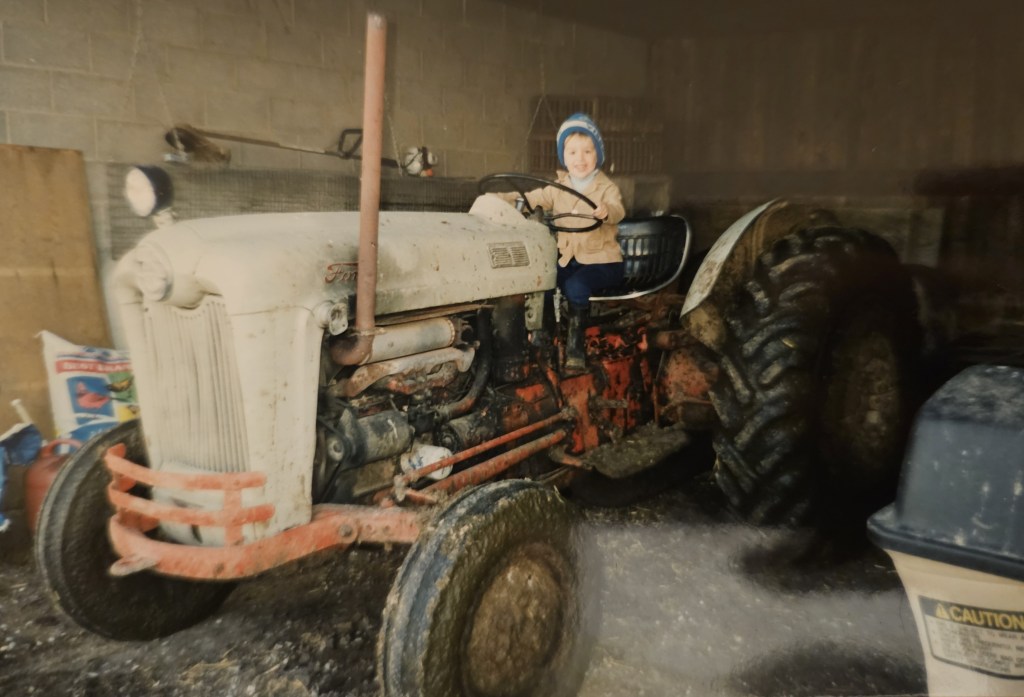
Growing up on a dairy farm, our first introduction to driving farm equipment was the Ford 860, an iconic little red & white tractor built in the 1950’s. Ours was equipped with a 6-foot box-scraper attached to its rear three-point hitch for the purpose of scraping the barnyard.
She went by various names: Pop called her the “860”. Sometimes she was just the “scraper tractor”. But the most common and affectionate moniker we gave to her was “Putt-Putt”, referring to the peculiar sound of her 4 cylinder gasoline engine.
Putt-Putt’s assigned resting spot was creatively named the “Putt-Putt” shed where she spent most of the day sitting quietly, surrounded by dirty rabbit cages, rarely-used step-ladders, an air compressor, and many other half-forgotten miscellaneous farm items.
A Ford 860 similar to the one I grew up with. (Ours was never this clean or shiny, though!)
A rite of passage for my brothers and me was the day we were deemed old enough to take over the daily chore of scraping the barnyard. The prescribed purpose of this event was to move the cow manure which had accumulated over the last 24 hours from the barnyard to the nearby “manure pile”. It was a fun job and one that we often looked forward to. It was however, a bit of a obstacle course.
Scraping the barnyard involved a good bit of maneuvering around the corral gates and the wooden posts of the feed bunk, among other things. It also included a lot of driving in reverse, neck craning, as you backed into the dark alleys of the freestall barn.
It was a well choregraphed dance of motor-skills, one hand gripping the steering-wheel, the other on the 3-point hitch lever ready to raise and lower at the appropriate time. One foot hovering over the clutch, the other resting on the brake.
Once you mastered the Beginner’s level, you would soon be taking advantage of the differential braking system. This feature was quite handy for turning sharp corners in tight places. Need to spin on a dime at high speed on slippery concrete? Just simultaneously cut the steering wheel while pressing the right or left brake. The one rear tractor tire would lock up while the other continued turning at said speed. Physics would take over, aided by the increased inertia of the scraper blade on the rear. 180 degree turn complete. Oh what joy!
The “Putt Putt” would eventually give up the ghost and be replaced by a diesel 70’s model Ford 4000 SU. She was our new scraper-tractor. We named her “Suzie” and my younger brother cut his teeth on her.
Besides scraping the barnyard, both little tractors served other useful purposes in their time. Before the days of our ATV 4-wheeler, we would drive the scraper tractor up our steep hill to bring the cows in from pasture. Years of cow paths and erosion had caused some limestone ridges to become exposed. It was anything but gradual and smooth. If you drove past our farm at the right time on a summer afternoon, you would see a little tractor picking its way up the hill with front wheels bobbing and nose pointed toward the sky. The heavy scraper shifted the center of gravity toward the rear and also acted as a handy “wheelie-bar” to keep you from flipping backwards. This too brought exhilarating joy.
Teaching his sons to scrape the barnyard came at a cost for my Father, however- mostly in the form of the money and time it took to replace the gates and posts which fell victim to the onslaughts of a greenhorn scraper-tractor operator.
Boy, did we ever beat stuff up! Whether it was barnyard accidents or otherwise, we children unleashed our share of collateral damage on the farm. I remember one such time, as one of my siblings pulled into our driveway with a larger tractor pulling a disc harrow behind. They failed to take a wide enough turn, and the disc caught the corner of our garage, leaving behind a gaping hole amidst a tumble of broken concrete blocks.
Time and memory would fail me to tell all the tales those old walls would hold- where youthful vigor and novice skill collided with wood, steel, and concrete.
It’s the price of raising up children. And through it all, I have no memory of Pop getting angry at us. Now as a dad myself, I have new respect for that.
Pop never got upset at us children for bungling jobs that he could have done better.
Mind you now, Pop is not a man who would be described as mild, quiet, or laid-back. His voice (which I didn’t inherit) is quite ample, shall we say. Pop’s never yet been documented as having raised the dead with one of his full-throated yells…but he sure can rouse the sleeping! He’s been known to stop a car in its tracks leaving our driveway with the windows rolled up, the bewildered driver perplexed by the clap of thunder on a blue-sky day.
If you were to make a phone call to Pop from the front yard of our house, and he answered from an open-seated tractor at the back our long field lane, you would experience a curious echo effect. His voice would be reaching your ears via satellite connection AND good old fashioned sound-waves rolling their way in from back-forty. You get the point.
Pop never got upset at us children for bungling jobs that he could have done better.
A Ford 4000 SU similar to our “Suzie”
Tractors die and boys grow into men. But I think teaching our children how to mow the lawn, till the garden, and drive the car point to something even deeper that we Moms and Dads face with each new season of child-training.
Raising children for the Lord is like walking a tight-rope of faith. On one side of the balancing bar is our desire to provide for and shelter them. On the other side is the recognition that without personal, trial-and-error experience, they will experience limited growth.
And so, one step at a time, we prayerfully walk the fine line. We teach them concepts and values. We try to lead by example. We warn of dangers. But at some point, we must step back and let them try to do what we can surely do better. Because, believe it or not- someday that may surpass us.
We must allow them the space to break things.
Can they go swimming with friends? How about that sleepover? Which books do we allow on our shelves? Sending them off to school. That weekend trip. Going on their first date. You name it.
Each parenting decision must balance our intense desire for their physical and spiritual safety with the understanding that our children need to be given enough rope so that they can learn the ropes.
Because, we are raising the next generation. A generation that will need to take the reins of a volatile society. A generation who will lead the Church in perilous times. Wow, that’s heavy.
Thankfully, Father God finishes raising his children, once their parents have tried and done their best. It’s called sanctification.
One of my last major incidents involving farm equipment and defenseless barns happened when I was an older teenager. The job at hand was hauling out the bed-pack manure from our dry cow pen, using our New Holland skid-loader (gone were the days of Putt-Putt and Suzie).
As I exited with another full skid-loader bucket of manure to dump in the spreader, I failed to see how high the boom was raised, and it caught the header above the large sliding door. Hunkering in the cab, I was suddenly engulfed in a deluge of raining concrete blocks along with decades of dust from the loft above. It seemed the whole structure might be collapsing around me!
The aftermath of my handiwork with the skid-loader. (Thankfully, the barn was soon going to be torn down and upgraded anyway)
After the dust settled, and I realized I was still here in the land of the living, I tucked tail and plodded into the house to tell Pop. He was taking his after-lunch nap on the living room sofa, covered in his customary blanket and face-pillow.
“Welp”, I began in a dead-pan phlegmatic tone. “I just got done basically knocking the freestall barn down.”
Pop sat up quickly, rubbing his eyes. His response still makes me chuckle to this day.
There are many ways a Father could respond to a son who just announced he succeeded in wiping out part of Dad’s crucial business infrastructure. I wonder how I would respond today in that situation. “Did you, though?!” doesn’t readily come to mind.
“Did you, though?!” The inflection of his tone would have seemed more fitting if I had just told him we had a new heifer calf born from our best cow…or maybe that I had just single-handedly cleaned out all the calf pens with pitchfork and wheelbarrow, without being told to.
“Did you, though?” That was it. No shouting. No scolding. No belittling.
I had broken something. Again. But it was fixable. Life would continue. Personal experience had taught me a lesson that over-sheltered protectionism never could.
God help me to extend the same grace to my sons. Thanks Pop!
“Omnipotence and impotence, or divinity and infancy, do definitely make a sort of epigram which a million repetitions cannot turn into a platitude. It is not unreasonable to call it unique. Bethlehem is emphatically a place where extremes meet” –G. K. Chesterton1
Christ is first revealed to the sleeping world in the form of a newborn baby. This version of Jesus is, by far, the most palatable to the world at large. For it is only the most degraded, demonic dregs of humanity which are not in some way inwardly softened by the sight and sound of a tiny infant. We are drawn to innocence; we hover in concern over helplessness. We are charmed by beauty.
The praise in heaven spills over into the dark skies of Judea. The announcement of good tidings of great joy ring out and bounce across the foothills of Bethlehem. The shepherds fall to the ground in shock and awe, then conclude “Let us now go.. to see this thing which the Lord has made known to us!” 2
The birth of Christ, has arguably, had the most far-reaching influence across all eras and regions of civilization. Though often cloaked in dizzying consumerism and pagan tradition, the celebration of Christmas has infiltrated even the most secular of societies today.
The Magi of antiquity, squint in bewilderment at the appearance of the shimmering royal star, pore through their astrological charts, and then finally saddle their camels and plod westward in search of the King. Even so today, each Yuletide, the pagans, dusting off the old family Bible that lies dormant on the mantle, wiping the cobwebs from spiritually blind eyes, come trooping in to stare in perplexed wonder at the holy child, still sleeping peacefully.
Even so today, each Yuletide, the pagans, dusting off the old family Bible that lies dormant on the mantle, wiping the cobwebs from spiritually blind eyes, come trooping in to stare in perplexed wonder at the holy child, still sleeping peacefully.
Each year in America, as sure as the last brown leaves skitter across frosty fields and the decorative pumpkins and cornstalks find their final resting place in the dumpster- just as surely, the wooden figurines of Mary, Joseph and the shepherds are brought out from the hallway closet; the translucent plastic nativity models find their way into the front yards of middle-class America. And the baby? He still sleeps in the feed trough. Holy infant so tender and mild- sleep in heavenly peace. Ssshhhh! We must not, we MUST not wake him!
That is where most of the world would wish that the Christ child remain. The shepherds return to their fields happy and talkative. The Magi, after a moment of obesience, begin a long trek home, their hearts full, albeit a few pounds lighter and a great deal poorer.
Glory to God in the highest, and on earth peace, goodwill toward men! 3 As the last echoes of the heavenly choir fade back into silent night, a most sinister dynamic begins to take shape around the advent of this peculiar child. The powers of evil are mustering their forces to somehow hijack the divine purpose of the long-awaited Messiah. In an unseen realm where reality dwells, a fiery ten-headed dragon lurks in shadows, waiting to devour the child. 4
For even now, this little boy child elicits a reaction from a local Judean despot that would be a harbinger of the broader Jewish reception to his adult ministry. When his crafty questions to the chief priests and scribes fail to locate the alleged child King, Herod “the Great”, spurred by the gnawing insecurity which often besets such brutal tyrants, resorts to the most shocking measures to insure that his throne is secure. Young sons are ripped from their mothers’ arms and executed on sight. It is a massacre of the innocents. The blood flows red in Bethlehem, and Rachel again weeps for her children! 5 But the Christ Child evades the sword of Herod, saved by a warning dream, sent from his heavenly father to his earthly father.
They flee to Egypt. It is a powerful irony indeed to consider that it was the Egyption Pharaoh, who a millenia and a half before, because of those same insecurities, had instituted his own purge of Jewish baby boys. There was one particular child named Moses, floating among the bulrushes of the Nile, who was saved and would later be called to lead his people forth out of Egypt to the promised land. But this time, Pharaoh would be a refuge for the special child… But not for long. “Out of Egypt have I called my son,” wrote the prophet Hosea. An inspired Matthew the tax collector would later recall those prophetic words, connecting the dots as he traces this incredible narrative of God’s only begotten Son. 6
The magnitude of Jesus’ birth is not lost to everyone, however. Those few faithful souls who were longing and praying, recognized Him immediately.
Simeon, a just and devout man living in Jerusalem waited expectantly for the Consolation. Guided by the Holy Spirit, he came to the temple. He had been promised that he would not see death, until he had seen the Lord’s Christ. Simeon found the Christ in the form of an eight day old baby boy. I can imagine the old man, cradling the baby, with tears of joy streaming down his weathered cheeks. He could die in peace now. “For my eyes have seen Your salvation which You have prepared before the face of all peoples,” rejoiced Simeon. “A light to bring revelation to the Gentiles, and the glory of your people Israel!” 7
Likewise, the aged Anna from the tribe of Asher, who had seen more than a hundred Passover lambs bleed out, would recognize the Lamb of God in an instant. Anna was an ancient fixture of the temple courtyard, kneeling for years upon the cold stones in fervent prayer and fasting, and possibly living off of the occasional kind-hearted gesture thrown down by hurried passersby. Anna had found her Redeemer. And she could not keep silent, speaking of Him to all those who looked for the Redemption in Jerusalem. 8
The little boy is taken home to Nazareth with his parents. He grows and becomes strong in spirit.
It is at this point, that the seeker of truth must make a choice. Will I pretend that the baby is still lying in the manger, or do I continue to follow His life journey? Will I, like his mother, although not fully understanding the meaning of “my Father’s business”, still keep all these things hidden in my heart? 9
It is at this point, that the seeker of truth must make a choice. Will I pretend that the baby is still lying in the manger, or do I continue to follow His life journey?
Indeed, the true worshiper of Christ must, like Him, increase in wisdom and stature. We must follow the dusty path back up to Galilee, where we are drawn to the banks of the Jordan river by the booming voice of a man clothed in camel-hair and leather. A man who flings incendiary accusations at the self-righteous elites. John the Baptist isn’t one to mince words. His listeners’ ears tingle as he fires verbal grenades like “wrath to come”, “brood of vipers”, and “the ax is laid to the root of the trees”.
Now as the people were in expectation, Luke records, and reasoning in their hearts about John, whether he was the Christ or not, he answers the question, pointing to them of One greater who was soon coming. One who would baptize with the Holy Spirit. One who would clean. Purge. Gather. And burn. 10